
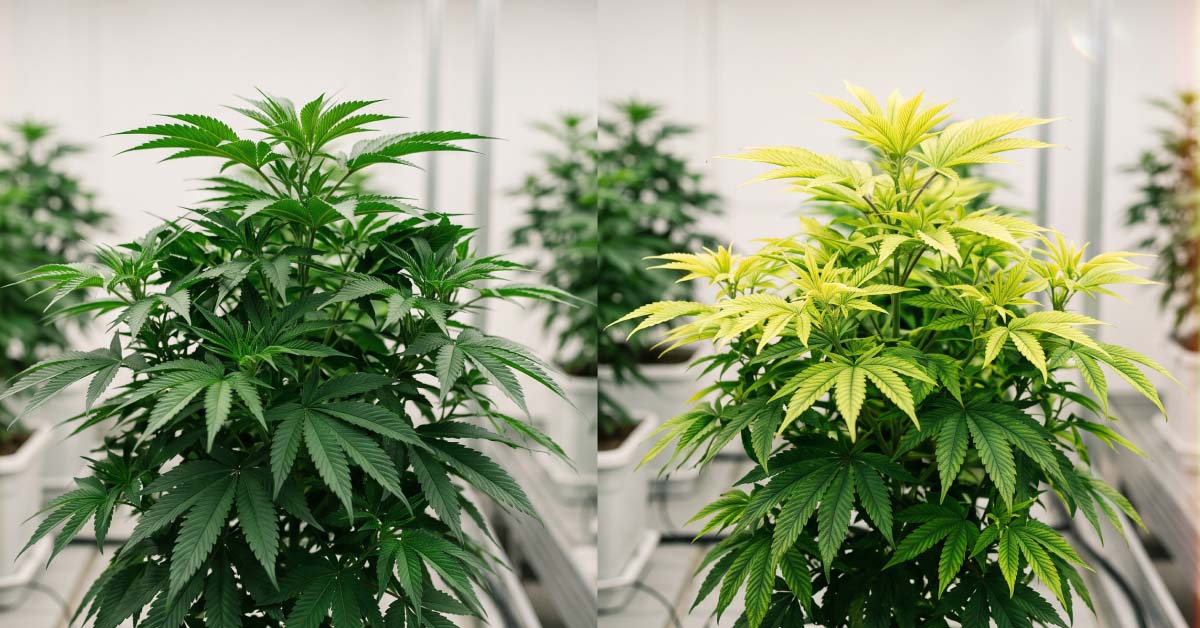
Iron deficiency ranks among the most common nutrient problems growers run into, and it shows up first in the plant’s freshest growth.
Iron drives chlorophyll production, so a plant running low fades its new leaves toward yellow and loses the green it needs to photosynthesize. Left alone, that yellowing spreads, growth stalls, and bud sites thin out. The good news is that iron deficiency moves slowly and responds well once you find the real cause.
At a glance: the quickest way to read the plant is to look at the top. Iron deficiency turns the newest leaves pale yellow while the veins stay green, and it’s almost always pH lockout rather than a real shortage of iron. Fix the root-zone pH first. Soil runs fine anywhere from 5.5 to 6.5, but aim for the 6.0 to 6.3 sweet spot before reaching for any iron product.
What Does Iron Deficiency in Cannabis Look Like?
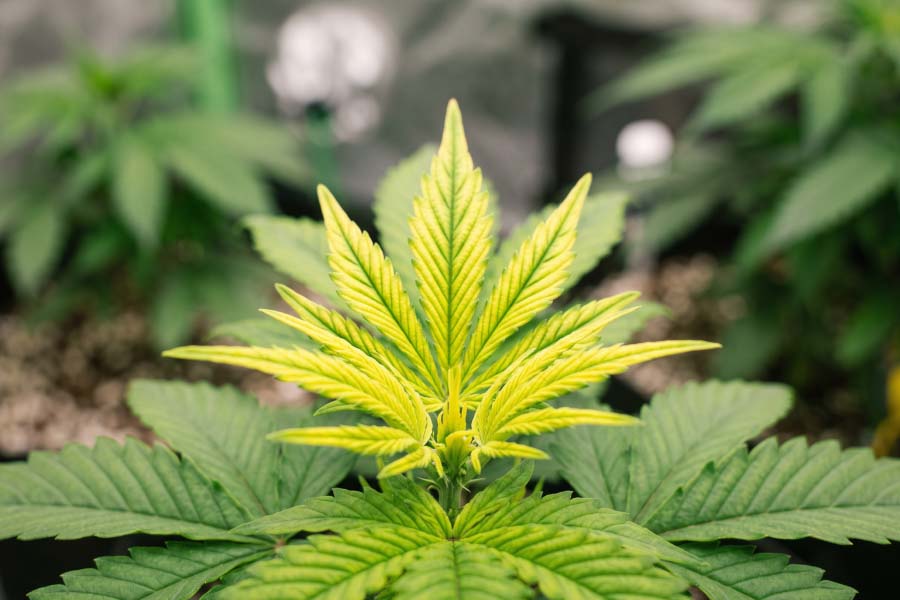
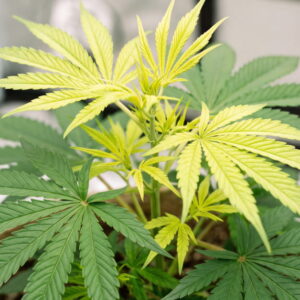
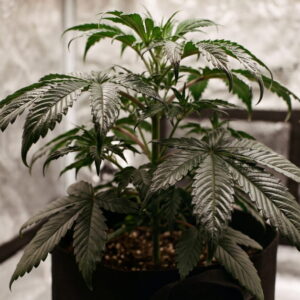
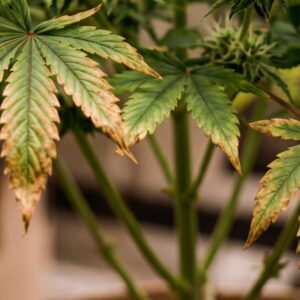
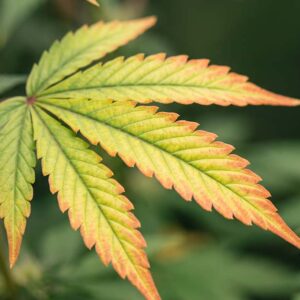
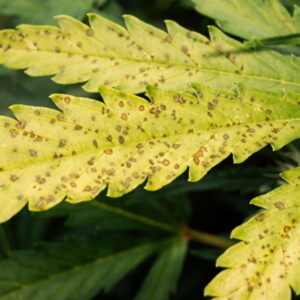
Iron deficiency looks like a pale, washed-out top canopy sitting above healthy green lower leaves. The fading concentrates between the veins, so each young leaf keeps a green skeleton of veins over a yellowing background, the pattern known as interveinal chlorosis.
It clusters at the top because iron cannot travel once it settles in a leaf, leaving the newest growth to run short first. Getting that top-down read right is what separates a correct fix from weeks of treating the wrong deficiency.
This section breaks the diagnosis into three parts:
- Early signs — what the first pale leaves look like before the problem spreads.
- Late signs — how the yellowing changes as the deficiency deepens.
- Iron vs other deficiencies — how to separate iron from the lookalikes that fool growers.
Early Signs of Cannabis Iron Deficiency
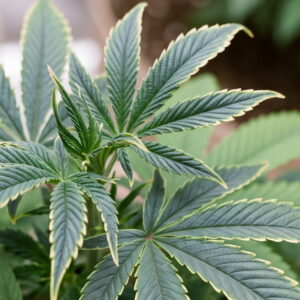
The earliest stage is easy to miss because the fade is faint: a slight lime or mint cast on the newest leaves rather than a clear yellow. It usually appears on the small upper leaves and the growing tip first, often just one or two nodes before anything obvious shows.
Only the freshest leaves are affected at this point; anything more than a few days old still looks normal.
Catching it at this cast-of-color stage gives you plenty of time to correct the root zone before any leaves are lost.
Late Signs of Cannabis Iron Deficiency
Late-stage iron deficiency spreads the yellowing across the whole leaf and pushes it down toward older growth. The pale green deepens into a brighter yellow, and new leaves may emerge already discolored.
Iron chlorosis spreads slowly, so even at this stage the plant can recover once the cause is fixed. If it continues untreated, leaves drop, the plant stops stretching, and bud development suffers.
Iron Deficiency vs Other Cannabis Deficiencies
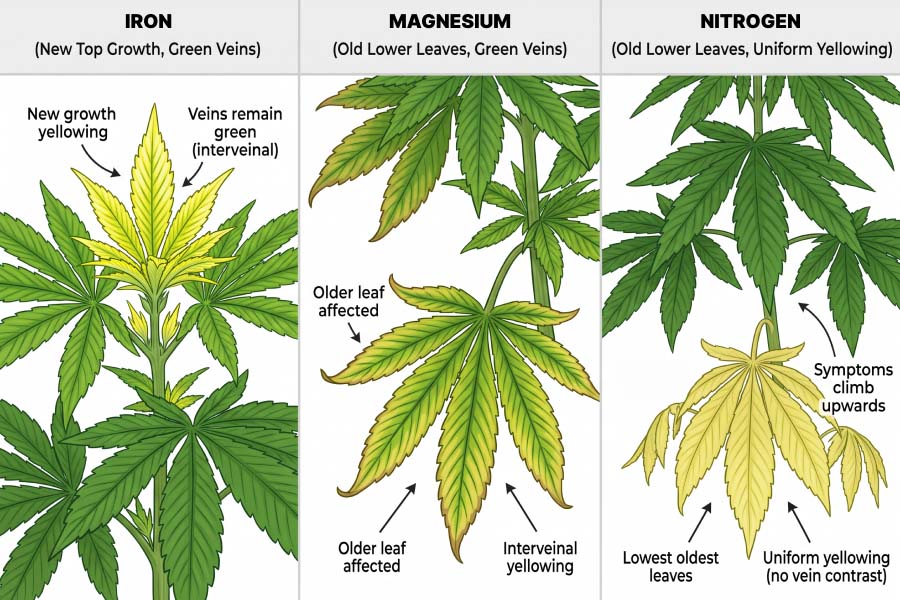
Where iron trips growers up is manganese and zinc, since those two also hit new growth and can look almost identical at a glance. Magnesium and nitrogen are easier to rule out because they start on the older lower leaves instead.
The safest approach is to check leaf position and vein color together before dosing anything.
Iron deficiency
- Where it starts: Newest top leaves
- Vein color: Veins stay green
- Pattern: Interveinal, top-down
- Common trigger: pH above approximately 6.5 or coco coir
- Spread speed: Slow
Magnesium deficiency
- Where it starts: Older lower leaves
- Vein color: Veins stay green
- Pattern: Interveinal, bottom-up
- Common trigger: Cal-mag shortage
- Spread speed: Moderate
Nitrogen deficiency
- Where it starts: Older lower leaves
- Vein color: Whole leaf yellows evenly
- Pattern: Uniform, bottom-up
- Common trigger: Low feed or late veg
- Spread speed: Moderate
Reliability of these indicators
- High: Where symptoms start and vein color
- Medium: Symptom pattern and common trigger
- Low: Spread speed
Leaf position and vein color are the high-confidence signals, so lead your diagnosis with those two.
The guide below turns what you see into what you should do:
Yellow New Top Leaves With Green Veins
- What it means: Classic iron deficiency
- Confidence: High
- What to do: Check pH, clear salt buildup if present, then apply chelated iron.
Yellowing on Old Lower Leaves
- What it means: Likely magnesium or nitrogen deficiency, not iron
- Confidence: High
- What to do: Don’t add iron. Diagnose the actual cause first.
Yellowing Everywhere at Once
- What it means: pH lockout affecting several nutrients
- Confidence: Medium
- What to do: Clear any salt buildup first and correct pH before adding nutrients.
Green Returns After a pH Fix Alone
- What it means: It was lockout, and iron was already present
- Confidence: High
- What to do: Keep pH stable. No additional iron is needed.
What Causes Iron Deficiency in Cannabis Plants?
Iron deficiency in cannabis usually comes from pH lockout, not from a real lack of iron in the medium. Most soils and feeds already contain enough iron, but the roots cannot absorb it when conditions push it out of solution.
Pinning down which condition is at work is what lets you both fix the plant now and keep the problem from coming back.
Four causes account for nearly every case:
- pH lockout — the root-zone pH climbs too high and iron stops dissolving.
- Excess of other minerals — competing nutrients crowd iron out at the root.
- Overwatering and poor drainage — waterlogged roots cannot take up iron.
- Coco coir — the medium binds iron and holds little of its own.
pH Lockout and Cannabis Iron Deficiency
pH lockout causes most cannabis iron deficiency because iron stops dissolving once the root-zone pH climbs above roughly 6.5 in soil. Iron only stays available to the roots inside a narrow band, so a small drift upward can trigger yellow new growth even when the medium is full of iron.
Soil is workable across 5.5 to 6.5, with 6.0 to 6.3 the sweet spot. Coco and hydro run 5.6 to 6.4, ideally 5.8 to 6.2. Read it off a calibrated pH meter.
Hard tap water and salt buildup both nudge pH upward over time, so retest regularly rather than assuming it holds steady.
Excess Nutrients That Block Iron Uptake
Even at a correct pH, too much manganese, zinc, copper, phosphorus or calcium can lock iron out by competing for the same uptake channels at the root. The roots can only pull in so much of these related minerals at once, so a surplus of one edges the others aside — iron included.
That makes overfeeding a common own-goal: the plant is surrounded by iron but blocked from using it. Keeping the nutrient mix balanced, and flushing when salts build up, clears the path so iron gets through.
Overwatering and Poor Drainage
Overwatering and poor drainage starve roots of oxygen, which stops them absorbing iron even when iron sits right beside them. Compacted, water-logged soil chokes the fine root hairs that pull minerals into the plant.
Clay-heavy mixes hold too much water, so most growers use a well-draining potting mix instead. Matching your watering rhythm to how fast the medium dries keeps the roots working.
Growing in Coco Coir
Coco coir triggers iron deficiency more often than soil because it holds little natural iron and tends to bind it against the roots. The medium also carries a high salt content that competes with iron uptake.
Growers in coco should feed a complete nutrient line with added iron and hold pH slightly lower, around 5.8 to 6.2. Regular runoff checks catch salt buildup before it locks iron away.
ONE KIT, FULL GROW
- Full-cycle nutrition, no guesswork
- Sweeter, more flavorful buds at flower
- Matched formulas designed to work together
- Perfect for soil, coco, and soilless media
How Do You Fix Iron Deficiency in Cannabis?
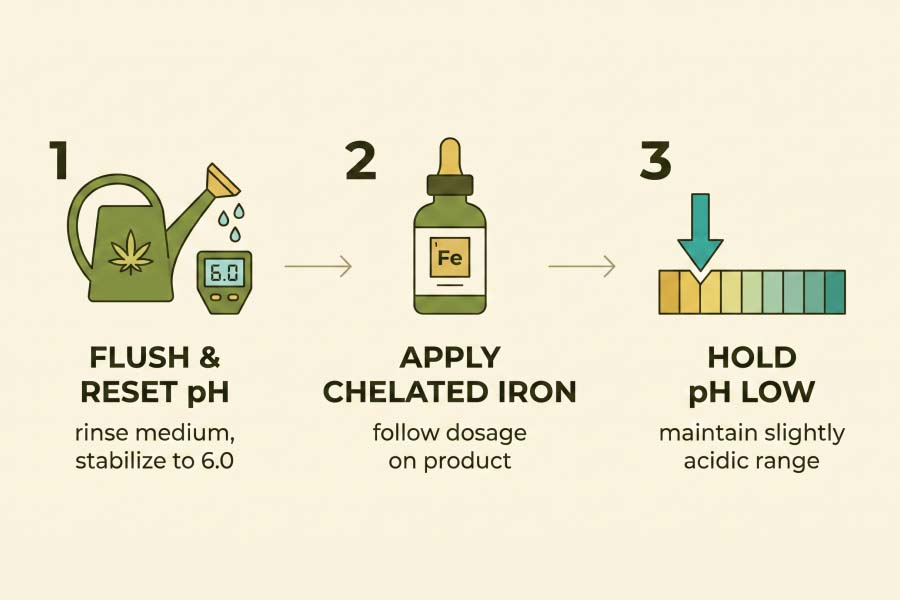
You fix cannabis iron deficiency by correcting the root-zone pH first, then adding available iron only if symptoms continue. Since the pH is usually the real culprit, resist the urge to dose iron straight away and work through the steps in order.
The fix has three moves, from first response to long-term hold:
- Clear salt buildup, then correct pH — to keep iron available.
- Apply chelated iron — restore green to affected leaves fast.
- Use soil amendments — hold pH low so iron stays available.
Clear Salt Buildup, Then Correct pH
High pH is the usual driver of iron lockout, and salt buildup can push pH up and compete for uptake on top of it. If your runoff EC is high, clear the salts first. Rinse the medium with mildly acidic water (about pH 5.8 to 6.0) until roughly 30% runs out the bottom. Whatever the runoff pH reads, use it only to spot drift, not as the figure you adjust toward.
Then correct the pH itself, which is the part that actually keeps iron available. In coco, hydro or soil fed synthetic nutrients, blend your nutrients into the water and pH that mix into range before it reaches the plant. pH Down is the usual fix (for high pH) but check the reading rather than assuming — acidifying a feed that’s already in range just overshoots the other way.
A living, organic soil regulates pH through its microbes, so genuine drift is rare. If it does show up, adjust with organic amendments instead (covered below). Follow up with a balanced feed at the right pH so the plant gets a clean, available meal.
Apply Chelated Iron to Affected Leaves
Chelated iron restores green to affected leaves faster than any soil amendment because the chelate keeps iron soluble at the root and leaf surface.
Choose the chelate to match your pH: Fe-EDDHA stays available above 6.5, while Fe-EDTA only holds up in acidic conditions, roughly below pH 6.0, and fails once the root zone climbs past there.
A foliar spray greens up existing leaves, but it only treats the growth present at the time, so repeat as new leaves appear. Treat chelated iron as a bridge while the pH correction takes hold.
Use Soil Amendments to Hold pH Down
Soil amendments hold pH low over time so iron stays available for the roots. Compost mixed into the top 6 to 12 inches builds organic matter and improves the soil’s buffering and drainage, and it feeds in a little iron as it breaks down. It steadies the root zone rather than forcing pH down on its own.
Elemental sulfur gives the longest-lasting correction, dug in about a year before planting for full effect. An acidic mulch like pine or peat moss worked into the mix also eases pH down slowly and suits an organic program. Skip lime here, it raises pH and would deepen an iron lockout.
If you feed your soil with synthetics, an ammonium-based nitrogen source (ammonium sulfate or urea) also acidifies as it works, at the recommended dose only.
Can You Over-Correct and Cause Cannabis Iron Toxicity?
Yes, over-applying iron can tip a plant into toxicity, though it happens far less often than deficiency. Too much available iron shows up as dark, dull leaves with bronze or brown spotting, usually starting on the older lower leaves and climbing upward, roughly the reverse of where a shortage appears.
It tends to follow repeated heavy dosing paired with a low pH that keeps iron highly soluble, or waterlogged, oxygen-starved roots that free up more iron than a healthy root zone would.
The fix mirrors the deficiency approach: flush the medium with correctly pH’d water and hold off on iron until new growth recovers. Dose to symptoms rather than on a fixed schedule and toxicity rarely becomes a problem.
Preventing Iron Deficiency in Cannabis Plants
Preventing iron deficiency starts with holding a stable root-zone pH and choosing a well-draining medium from the first watering. Test pH at every feed with a calibrated meter, keep soil inside 5.5 to 6.5 (ideally in the 6.0 to 6.3 sweet spot), and go easy on the feed, since excess salts are a common trigger.
Because iron shares uptake pathways with other trace minerals, watch for a manganese deficiency or zinc deficiency, both of which also strike new growth and are easily confused with iron.
Yellowing that starts on the lower leaves usually points to a magnesium deficiency rather than iron, so read leaf position before dosing. Keeping the full trace-nutrient balance in range also guards against a copper deficiency, which shows as yellow tips and wilting.
Stable pH, clean water, and measured feeding prevent most of these problems before a single leaf turns yellow.
How Seed Choice Affects a Plant’s Resistance to Nutrient Stress
Seed genetics influence how well a cannabis plant tolerates pH swings and nutrient stress before deficiency shows. Vigorous, stable genetics recover faster from a lockout event and forgive small mistakes in feeding and pH.
Starting from stable, well-bred cannabis seeds gives a plant the resilience to shrug off minor pH drift before chlorosis sets in.
Feminized cannabis seeds remove the male-plant variable, so a grower’s attention stays on pH and feeding rather than sexing plants. Autoflowering seeds keep things simpler still, running a short, hands-off cycle that gets a plant from seed to harvest fast — a forgiving choice for growers who want fewer moving parts to manage.
Neither choice replaces good root-zone management, but both reduce the number of variables a grower juggles while a deficiency is developing. Grow only where it’s legal to do so.
FAQs About Iron Deficiency and Cannabis
What Is the Best pH to Fix Iron Deficiency in Cannabis?
Soil holds iron well across 5.5 to 6.5, with 6.0 to 6.3 the sweet spot. Coco and hydro sit a little lower, 5.6 to 6.4 acceptable and 5.8 to 6.2 ideal. Iron drops out of solution outside that range, so correcting pH is usually the first and most effective step. Measure with a calibrated meter at every feed to keep the root zone in range.
How Do I Tell Iron Deficiency From Nitrogen Deficiency?
Iron deficiency starts on the newest top leaves and leaves the veins green, while nitrogen deficiency starts on the older lower leaves and yellows the whole leaf evenly. Check leaf position first: top-down yellowing points to iron, bottom-up yellowing points to nitrogen. The green-vein pattern confirms iron.
Why Does Iron Deficiency Happen More in Coco Coir?
Iron deficiency happens more in coco coir because the medium holds little natural iron and its salt content competes with iron uptake at the root. Growers in coco should feed a complete nutrient line with iron included and hold pH slightly lower, around 5.8 to 6.2. Regular runoff checks catch salt buildup early.
Does Weed Have Iron in It?
Cannabis, like most leafy plants, contains small amounts of minerals including iron, but the quantities in typical use are minor and not a meaningful dietary source. Cannabis is not consumed in the amounts needed to affect nutrition the way food does. For dietary iron needs, speak with a doctor or dietitian.
Can THC Affect Iron Levels?
Evidence on THC and iron levels in people is limited, and no reliable conclusion links THC use to changes in the body’s iron. Studies in this area are early and often inconsistent, so any personal concern is best discussed with a healthcare professional. This article covers iron in the cannabis plant, not iron in the human body.
Can Weed Cause Anemia?
There is no established evidence that cannabis use causes anemia, a condition defined by low healthy red blood cells or hemoglobin. Anemia has many recognized causes, most commonly dietary iron shortage, and diagnosing it requires a blood test. Anyone worried about anemia should consult a doctor rather than rely on general information.
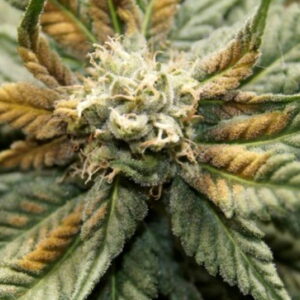
Think I’m going thru iron def
Hi can you spray iron chelate when flowing
Hi my name is johnathan williams and i am having trouble iding the problem i have a female she is big one but but her some of her leaves even thouh they are new growth they are strarting to dry out and curl up .sime leaves are showing some brown spots on on them. Help dont want to lose her so if you have any idea what i need to do would send you pick if i could aany help would be greatly accepted thank you
I’m trying to obtain a copy of your free download
of “Marijuana Grow Bible,” but it’s not going through.
Learnrd a hell of alot about lot about iron deficiency thank u
Geez that’s unreal ! Very impressed, thank you very much for the World Knowledge
EDDHA Iron Chelate versus EDTA Iron chelate…. what is the difference?
EDTA Iron fails when the pH exceeds 6.8. EDDHA remains available from a pH of 4.8 to 10.5
EDTA is often found in blends like 20-20-20 and remains availble for 3-10 days. EDDHA Iron remains available for 3-5 months. The EDDHA Iron molecule is significantly smaller than EDTA Iron… so it moves into the plant via mass flow.
When growers move from the Veg Stage to the Bud production stage they often will stop using 20-20-20 and by default, the EDTA Iron is gone within 3-7 days. By the time they reach harvest the plant is very yellow. If you want to see dark green foliage all the way thru harvest without a flush of growth, consider EDDHA Iron.
Consider the cosmetics too. I have strawberry growers who use EDDHA Iron for the purpose of making the calyx and stems dark green. Buyers get turned on to the way the berry is presented. Same goes for Cannabis Buds.
Nabta manufactures water soluble fertilizer, chelates and humic acid. Nabta sol EDDHA 6% Iron chelate is ground down to a very fine powder and can be applied as a drip/drench or as a foliar application. The only cautions are not to apply with Calcium… and do not apply as a foliar during periods of bright sunlight.
[…] the pH is too high, or your plant has an overabundance of iron, it may start showing evidence that it is lacking […]
[…] your plant has too much iron (Fe) or zinc (Zn), it will prevent your plant from absorbing phosphorus normally. There could be a […]
[…] your plant has too much molybdenum, on the other hand, it could be mistaken for a lack of iron or copper. Not sure if your plants have a molybdenum deficiency? Read the article Nutrient […]
[…] deficiencies are similar to manganese and iron deficiencies, accept that they influence new growth, causing them to become motionless. Zinc deficiency happens […]
[…] small amounts, especially when compare to the macronutrients. Micronutrients include zinc, copper, iron, boron, manganese, and molybdenum. A good option is the Marijuana Booster. A great product […]
[…] Iron deficiency […]
[…] Copper toxicity is when the plant has too much copper. This also means it is unable to use iron (Fe). […]
this was a very nice cite,Ihope it will help me alot, Thanks