
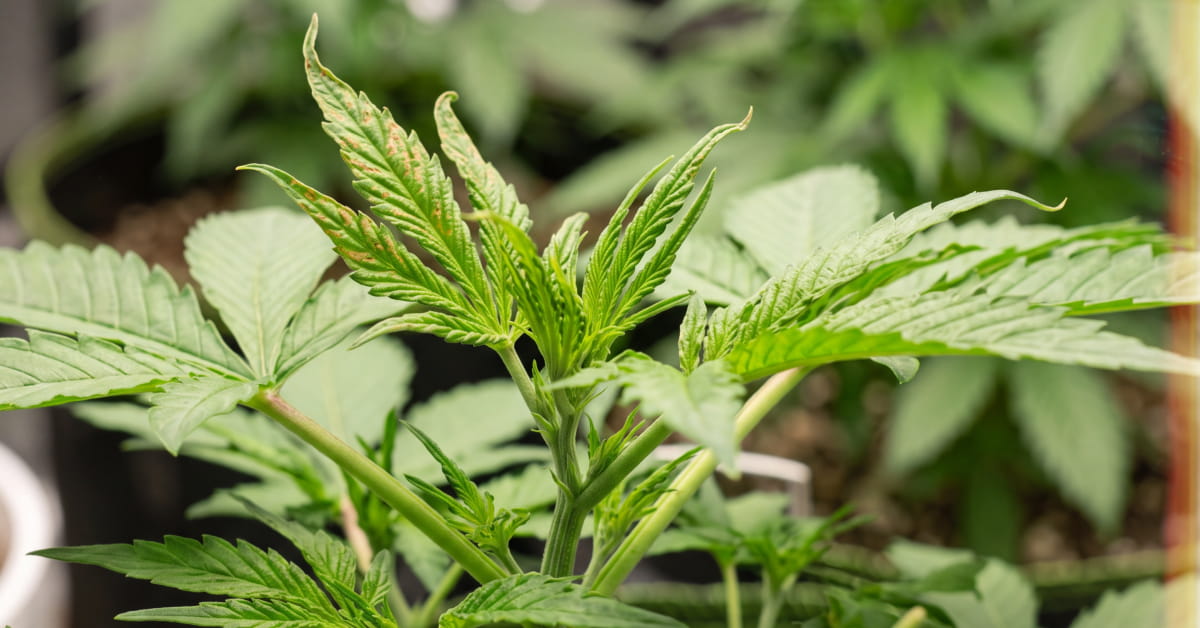
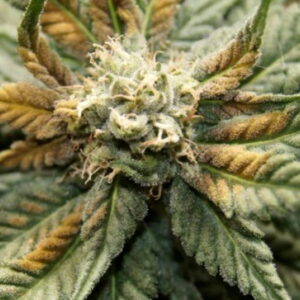
Calcium deficiency in cannabis weakens cell walls and stunts new growth, starting with large, irregular brown or rust-colored spots or ‘blotches’ on the youngest leaves near the top of the plant. Growers often call it a “cal-mag deficiency,” but a straight calcium shortage isn’t the same thing as a combined calcium and magnesium one, though they often co-occur together and share a fix.
Hydro, coco, and reverse-osmosis or distilled water growers hit it most. Caught early, new growth returns to normal within a week or two.
The key thing to know: it rarely means the plant has no calcium at all. Usually the root-zone pH has drifted and locked the calcium out. So check and correct pH first, and confirm the symptoms before reaching for a cal-mag supplement.
Learn more about how to provide your cannabis plants with the proper nutrients when you download my free Grow Bible.
What Is Calcium Deficiency in Cannabis Plants?
Calcium deficiency in cannabis plants develops when the roots can’t take up enough calcium to build new cell walls, stems, and root tissue. Calcium is the mineral that gives plant structure its rigidity, so a shortage leaves new growth soft, distorted, and marked with large, irregular blotches, while older growth often stays green.
Is a Calcium Deficiency the Same as a Cal-Mag Deficiency?
No, a calcium deficiency is a shortage of calcium alone, while a cal-mag deficiency means calcium and magnesium are both running short at the same time. They often get treated as one condition because they usually share the same root causes.
A magnesium deficiency doesn’t cause a calcium shortage but excess magnesium can actually suppress calcium uptake. That’s why overdoing the magnesium half of a cal-mag product can trigger a calcium problem, while overdoing calcium itself can slow potassium uptake instead.
What Causes Calcium (or Cal-Mag) Deficiency in Cannabis?
A calcium (or cal-mag) deficiency is typically caused by poor water, a growing medium with no mineral reserve, and pH drift, which is why both calcium and magnesium often show up together despite being separate shortages:
- pH lockout — root-zone pH outside the ideal range locks out cal-mag even when both are present in the feed. This is the single most common cause and the first thing to rule out.
- Water source — reverse-osmosis, distilled, and soft tap water carry little dissolved calcium or magnesium, so plants fed these need a cal-mag supplement from the start.
- Growing medium — hydroponic and coco setups hold no natural reserve of either mineral, and very acidic soils (common in pinewoods) lock calcium out specifically.
Most cases trace back to pH lockout more often than to an actual lack of calcium (or cal-mag) in the feed. This is why correcting pH fixes many cases without adding anything at all.
What Are the Signs of Calcium & Cal-Mag Deficiency?
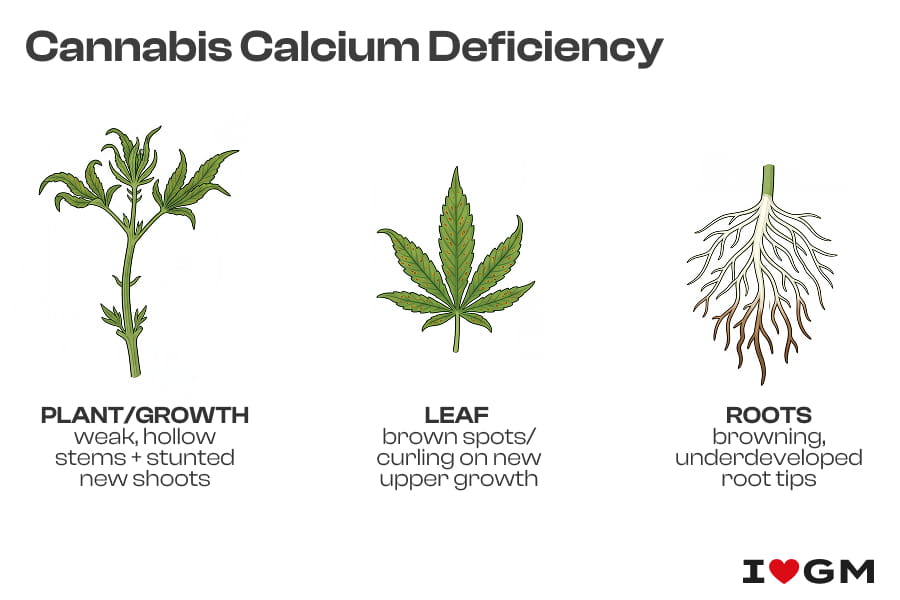
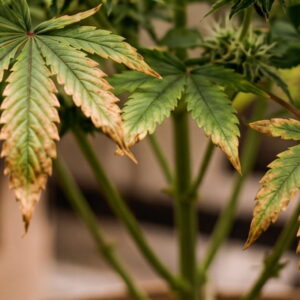
Calcium deficiency shows up as large brown or rusty patches on young leaves, curling leaf tips, and slowed shoot development. If veins stay green while the rest of the leaf turns pale yellow alongside those big blotches, magnesium is short too — classic signs of a cal-mag deficiency.
The symptoms group into three areas, and reading all three together gives a far more reliable diagnosis than any single sign:
- Leaf symptoms — the spotting, curling, and distortion you notice first.
- Plant and growth symptoms — stunted shoots, weak stems, and slow bud development.
- Root symptoms — browning, underdeveloped roots that struggle to feed the plant.
Leaf Symptoms of Calcium Deficiency
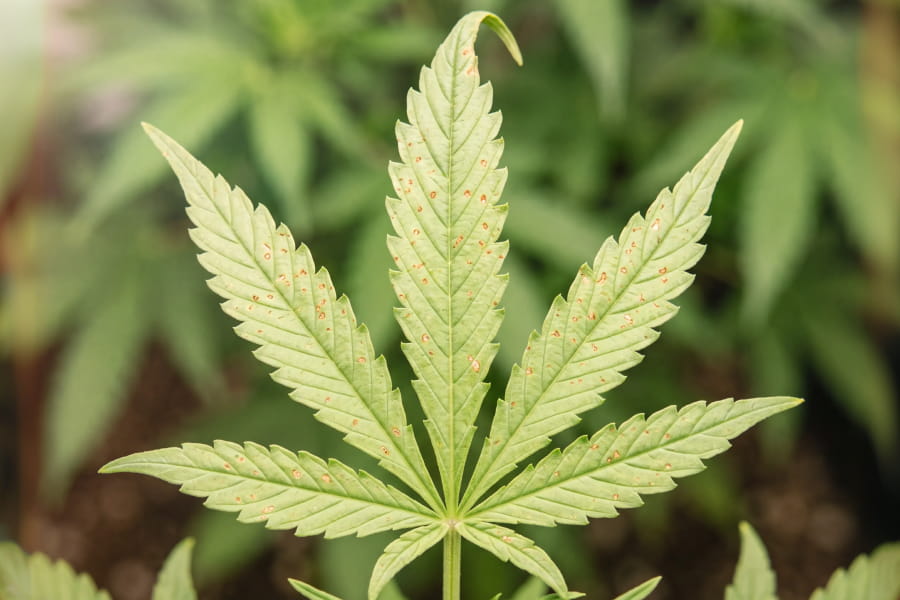
Calcium-deficient cannabis leaves develop large, irregular brown or light-tan necrotic blotches, most often on the newer upper leaves. The leaf’s green color can darken first, then the patches appear, sometimes with a slightly crinkled or mottled surface. New leaves come in small and distorted, and the tips curl instead of opening flat.
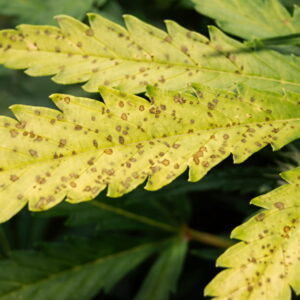
If you also see yellowing leaves with green veins alongside the big brown blotches, magnesium is short too. Smaller, more scattered brown spots point toward a boron problem, which behaves differently and needs its own fix (though it’s rare).
Plant & Growth Symptoms of Calcium Deficiency
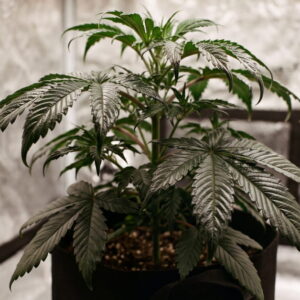
Calcium-deficient cannabis plants show stunted new growth because calcium builds the cell walls that let shoots extend and stiffen. Stems and branches turn weak, lose their flexibility, and crack easily. Young shoots crinkle and can discolor toward purple or yellow, and the plant handles heat stress poorly.
In flower, the damage costs the most. Bud development slows or stalls, and buds may never fully fill out, so a calcium or cal-mag shortage during flowering is worth catching fast.
Distinguish this from browning, burnt-looking leaf edges and tips, which usually signal a potassium problem rather than the interior spotting of calcium.
Root Symptoms of Calcium Deficiency
Calcium-deficient cannabis roots slow their development and can begin browning or dying back at the tips. Because calcium drives root-hair growth and overall root-system structure, a shortage leaves the plant with a smaller, weaker root mass that feeds the canopy poorly.
Underdeveloped roots also open the door to root rot and other root-zone diseases. Root symptoms are the hardest to see directly, so most growers confirm them only after pulling a plant or noticing the above-ground signs first.

ONE KIT, FULL GROW
- Full-cycle nutrition, no guesswork
- Sweeter, more flavorful buds at flower
- Matched formulas designed to work together
- Perfect for soil, coco, and soilless media
When Does Calcium or Cal-Mag Deficiency Appear (Veg, Flower, Autoflower)?
Cal-mag or calcium deficiency appears first in fast-growing tissue, so the timing tracks whichever stage is pushing the most new growth. In vegetative growth it shows on the upper shoots and middle canopy where the plant expands quickest. In early-to-mid flowering it can hit hard, because bud sites demand calcium heavily and any pH drift shows up fast on the new flower growth.
Autoflowers deserve extra attention here. A short-cycle plant has a tighter recovery window, so a calcium or cal-mag deficiency during flowering leaves less time to correct before harvest — catching it early matters more than it does on a longer photoperiod grow.
What Causes Calcium & Cal-Mag Deficiency in Cannabis?
Calcium and cal-mag deficiency traces back to pH lockout more often than to an actual lack of calcium in the feed. When root-zone pH drifts too low or too high, the roots can’t absorb the calcium that’s already present, so the plant starves in the middle of plenty. This is why correcting pH fixes many cases without adding any calcium at all.
Several conditions raise the risk, including growing medium, water source, and genetics:
- Water source — reverse-osmosis, distilled, and soft tap water carry little dissolved calcium, so plants fed these need it supplemented from the start.
- Growing medium — hydroponic and coco setups lack the calcium reserves that soil holds, and very acidic soils (common in pinewoods) lock calcium out.
- Light and genetics — some LED spectra miss wavelengths tied to calcium use, and certain strains, or even individual plants within one strain, run short while their neighbors thrive.

What Is the Best pH for Calcium & Cal-Mag Uptake?
Cannabis takes up calcium and magnesium best when root-zone pH sits inside a fairly narrow band, and that band shifts by growing medium.
In soil, aim for 5.5 to 6.5 (6.0 to 6.3 is the sweet spot). In hydro and coco, aim for 5.6 to 6.4 (5.8 to 6.2 hits the mark). Outdoor soil growers should target roughly 5.8 to 6.3. Drift outside these ranges, and both calcium and magnesium lock out even when the feed contains plenty.
Because pH is the real lever, measure it before adding any supplement. Test the runoff or reservoir, correct it into range, and give the plant a few days. Necrotic blotching that stops spreading on new growth is a good sign that pH was the cause.
How Do You Fix Cannabis Calcium & Cal-Mag Deficiency?
To fix a cannabis calcium or cal-mag deficiency, correct the root-zone pH first, then supplement calcium and magnesium if the big brown blotches along with yellowing leaves and green veins still show up.
Prevention beats correction: a balanced nutrient line fed at the right strength keeps calcium steady and stops most deficiencies before they start.
When a shortage does appear, the fix depends on your medium. The approach splits three ways according to on how you grow:
- Soil — adjust pH and add slow- or fast-release calcium sources.
- Hydro and coco — dose cal-mag directly into the reservoir or feed.
- Outdoors — amend the soil itself with lime or gypsum before or during the season.
Fixing Calcium Deficiency in Soil
In soil, calcium lockout is almost always a low-pH problem, and how you correct it depends on your feed. In organic soil the root-zone microbes regulate pH themselves, so only correct genuine pH drift with organic amendments. Dolomitic or garden lime is ideal — it raises pH slowly while feeding calcium at the same time (worked into the medium for the long term).
If you feed synthetic nutrients in soil, treat it like coco or hydro. Dissolve your nutrients into water and bring that feeding mix into range with pH Up or pH Down before watering. With pH handled, match the calcium source to how fast you need results.
Lime is the slow, steady option. For quicker uptake, a cal-mag supplement, liquid calcium, or liquid lime absorbs fast through the roots (roughly a teaspoon of hydrated lime per gallon or about 1.3 ml per liter). Calcium nitrate dissolves cleanly and acts fast, but keep it out of the feed during flowering, since it adds too much nitrogen for that stage.
Flushing is a separate job for clearing salt buildup. Use plain pH-corrected water (with no nutrients added) and run until about 30% drains, then supplement.
Fixing Cal-Mag Deficiency in Hydro & Coco
Hydro and coco growers add cal-mag directly, since these media hold no natural calcium reserve and many fertilizers assume the tap water supplies some. As a rough guide, water above 125 ppm of dissolved solids usually carries enough.
For anything below that, add calcium and magnesium to reach a safe baseline. Liquid calcium, liquid lime or a cal-mag supplement all cover both minerals in one step.
Keep the pH of the solution you feed between 5.6 and 6.4 (ideally 5.8 to 6.2) so what you add stays available. Always mix nutrients into the water first, then adjust the pH of the finished solution — the nutrients shift it as they go in.
In coco, do this for every batch before watering. In a recirculating hydro system, hold the reservoir in range and check it daily as the plants drink it down. If it drifts, bring the mixed solution back with pH Up or pH Down (in hydro you can also mix a fresh reservoir).
Don’t confuse any of this with flushing, which only clears accumulated salts. When you do need it, use plain pH-corrected water — never a feed-laced rinse.
Fixing Calcium Deficiency Outdoors
Outdoor growers raise soil calcium with lime or gypsum, and outdoor plants rarely go short unless the soil is very acidic.
For acidic ground, work in dolomitic lime, garden lime, crushed eggshells, seashell, or fish bones to lift pH toward the ideal 5.8 to 6.3 and hold calcium in the soil for the long haul. Gypsum, or calcium sulfate, is another option that adds calcium without moving pH much, which suits soil already in the right range.
One caution: never add gypsum to soil below pH 5.5, because it can react with aluminum and harm the plant, so test the soil first.
What Does Cal-Mag Do for Cannabis Plants?
Cal-mag supplies cannabis plants with the calcium and magnesium they need for structure and photosynthesis in a single product.
Calcium builds and strengthens cell walls, drives root growth, and keeps nutrient uptake running smoothly. Magnesium sits at the core of every chlorophyll molecule, so it powers the plant’s ability to turn light into energy.
Growers keep a cal-mag supplement on hand because the two shortages so often appear together, and one bottle addresses both at once.
Leaf Septoria vs Calcium Deficiency: How to Tell Them Apart
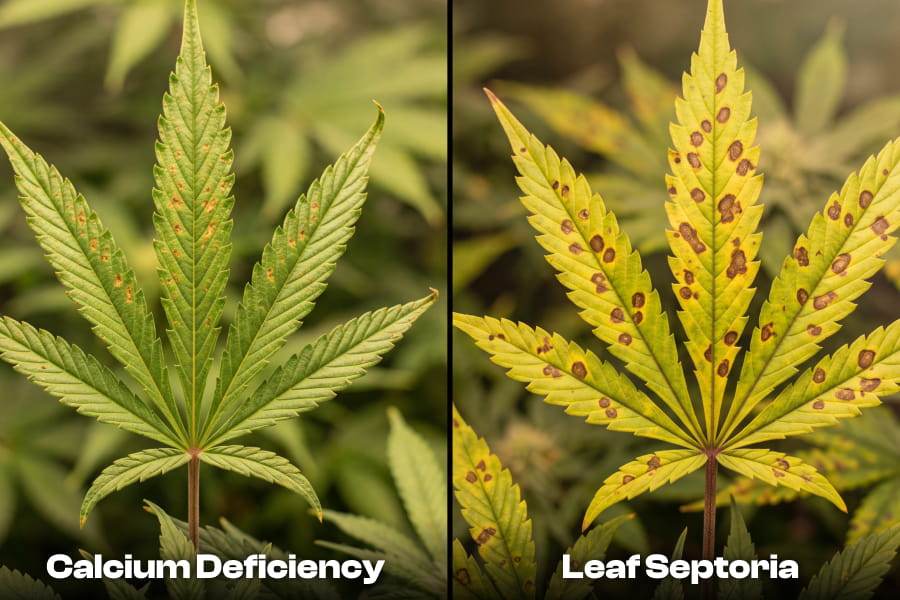
Leaf septoria and calcium deficiency both spot cannabis leaves, but septoria spreads as a fungal disease while calcium deficiency stays put and reflects a nutrient or pH problem. Getting this right matters, because a fungus needs isolation and treatment, while a deficiency needs a pH check and a supplement.
The pattern and location of the spots tell them apart. The table below breaks down the differences and how much to trust each one:
| Trait | Low Calcium | Leaf Septoria | Trust Factor |
| Spot location | New, upper growth first | Lower, older leaves first | High |
| Spread | Stays local, no new spread | Spreads upward, plant to plant | High |
| Halo | No yellow ring | Yellow ring around each spot | Medium |
| pH / cal-mag fix | Improves within days | No change | High |
The single most reliable check is the response to correction: fix pH and add cal-mag, and calcium-deficiency spotting stops on new growth within days, while septoria keeps advancing regardless. Small dark or black spots that start low and climb, often with yellow halos, point to septoria or a fungal issue rather than a mineral shortage.
Mineral lookalikes exist too: interveinal yellowing with brown blotching leans toward a combined cal-mag deficiency rather than calcium alone, while smaller, more scattered necrotic spots point to a boron deficiency instead.
Can You Overfeed Calcium? Cannabis Calcium Toxicity Explained
Yes, cannabis can take up too much calcium, though calcium toxicity is far less common than deficiency.
The bigger risk from overfeeding is nutrient lockout: at normal levels calcium actually supports the plant’s potassium uptake, but push it too high and that relationship flips — excess calcium starts slowing potassium absorption instead, so over-correcting one problem can trigger another.
Burnt tips and edges on older leaves lower down point toward a potassium deficiency, which could be a sign of calcium toxicity. If you suspect a single heavy dose rather than ongoing overfeeding, skip calcium (or cal-mag) on your next feeding, water with your normal balanced nutrients instead, then ease back into full-strength calcium / cal-mag once new growth looks normal.
If you’ve been overfeeding for a while and you’re seeing burnt, crispy leaf tips on newer growth that keeps getting worse feed after feed, that’s usually a sign of general overfeeding or nutrient burn. Flush the medium to reset the root zone, then resume feeding at normal strength.
Worth a quick check if you’re dosing a cal-mag product: excess magnesium can lead to calcium lockout, so confirm which half is actually overdone before treating it as a calcium problem. Signs include a plant that develops fresh deficiency symptoms shortly after a heavy calcium dose.
How Seed Genetics Affect Deficiency Resistance
Cannabis seed genetics influence how well a plant resists calcium and cal-mag stress, because vigor, root strength, and nutrient efficiency all trace partly back to the seed.
Starting with healthy, stable marijuana seeds gives a plant the strong root system and steady growth that shrug off minor pH swings, where a weak or unstable start makes every deficiency hit harder. Genetics won’t override bad pH, but resilient stock buys margin for error.
For an all-female grow with no males to spot and remove, feminized cannabis seeds keep the whole canopy productive and on one feed schedule. Short-cycle growers choosing autoflower weed seeds should feed lighter, since autos need lower nutrient concentrations than photoperiod plants and tip into lockout easily.
Choosing stable seeds, for eligible adult buyers where cultivation is permitted, sets the plant up to handle nutrient stress before it ever reaches the pot.
FAQs About Cannabis Calcium & Cal-Mag Deficiency
How Do I Know If My Cannabis Plant Has a Calcium Deficiency?
Look for large, irregular brown or rust-colored blotches on the newest upper leaves, paired with curling tips, weak stems, and slowed new growth. If the necrotic patches stay on young growth rather than old fan leaves, and improve after a pH check and cal-mag dose, calcium deficiency is the likely cause.
What Does Cal-Mag Do for Weed Plants?
Cal-mag supplies both calcium and magnesium in one product. Calcium strengthens cell walls, roots, and stems, while magnesium powers chlorophyll and photosynthesis. Growers use it because the two shortages usually appear together and share the same fix.
Why Are My Cannabis Leaves Pointing Up?
Leaves pointing or praying upward often signal healthy, happy plants under good light. Combined with brown spots or curling tips, though, it can accompany nutrient or environmental stress, so check pH and recent feeding before assuming a deficiency.
What Are the Black or Dark Spots on My Cannabis Leaves?
Small black or dark spots that start on lower leaves and climb upward, often with yellow halos, usually point to leaf septoria or another fungal issue rather than a calcium shortage. Calcium-deficiency spots stay on new growth and don’t spread plant to plant.
Can Cal-Mag Deficiency Happen in Flowering?
Yes, cal-mag deficiency can appear during flowering, when bud sites demand calcium heavily and pH drift shows up fast on new flower growth. Catch it early, because a shortage at this stage can slow or stunt bud development.
Is Cal-Mag Deficiency Worse in Autoflowers?
Cal-mag deficiency isn’t more likely in autoflowers, but it’s harder to recover from. A short life cycle leaves a tighter window to correct the problem before harvest, so early diagnosis matters more on autos than on longer photoperiod plants.




What if it is ornge color
What is the correct ppm scale for the suggested 150ppm ppm5 or ppm7?
thanks
What does this look like?
Should we pick off all the affected leaves? I am nervous to trim too much and then stress the plant….
Francesca,
Once a leaf has as much as 60% damage to the leaf; It is best to remove it. The plant will waste energy attempting to heal the leaf. Once gone energy can be used by the plant normally. – I❤️GM
How about addressing Calcium deficiencies in LED grows ?
Thanks Dickie. Robert’s not in so I added a line myself. It’s a rather complex story about the ionisation of the calcium which I did not want to get into atm. If you have any info for me I’m all ears 🙂
It is always advisable to have some CalMag on hand. The Marijuana Booster is a full range nutrients and should be OK as a stand alone nutrient system. However; If you have a Calcium deficiency, then it might be advisable to apply CalMag 🙂
Happy Growing
believe I do have calcium problem, does the marijuana booster help this problem or do I need some calmag?
[…] that cannabis plants need the most. This list includes phosphorus, nitrogen, potassium, magnesium, calcium, and sulfur. Micronutrients refer to the remaining nutrients that are necessary for a plant to […]
So you recommend that water/nutrient solution should be PH’d to 6.2-6.5 in hydro or coco coir? Seems like I see everybody running 5.8-6.0?
A PH of 5.8 is the recommended PH for hydro systems under normal circumstances. I believe Robert was applying an adapted PH level to help counter the Calcium deficiency.
[…] of all, Calcium is one of the major micro elements. It bears the symbol ‘’Ca’’ in the Periodic table of […]
[…] Calcium deficiency […]