
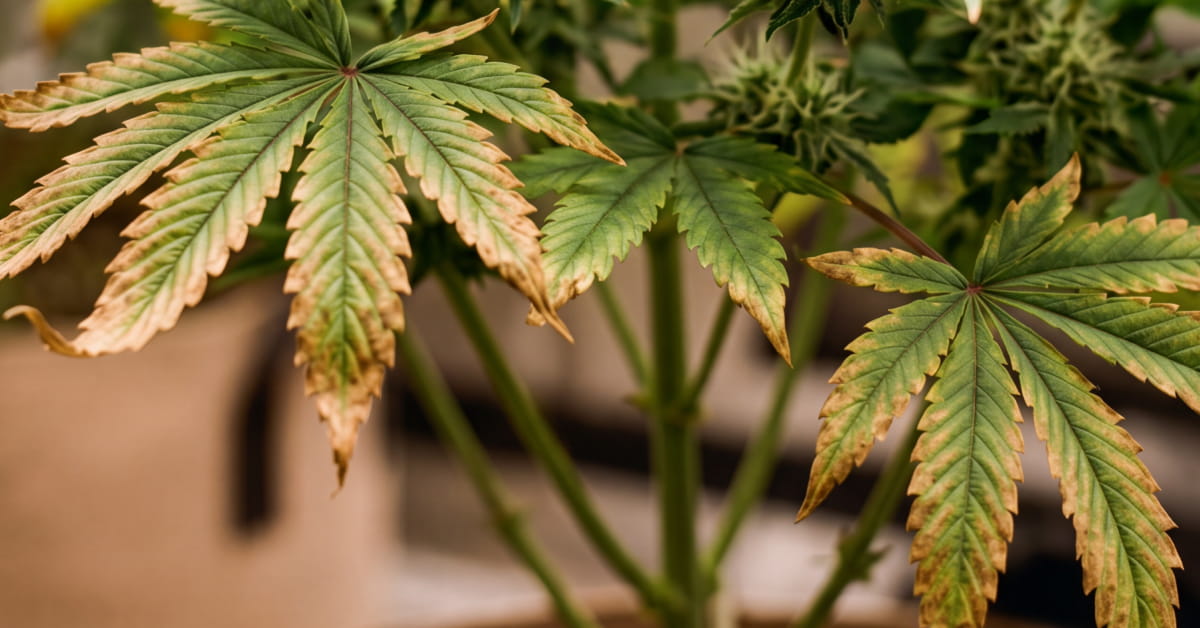
Cannabis potassium deficiency shows up as brown, crispy edges on the lower leaves, burnt tips, weak stems, and buds that stop filling out. Potassium is a mobile nutrient, so a plant running short pulls it from older growth to feed new growth, which is why the damage starts at the bottom and climbs.
Spotting it early lets you correct the shortage before it cuts into bud development during flowering.
Quick read: Brown edges and burnt tips on the older, lower leaves point to a potassium shortage, while damage on the newest leaves points to nutrient burn. Before you add anything, check root-zone pH, since locked-out potassium mimics a true shortage.
Download my free marijuana grow guide and start growing high-quality strains. High-quality strains are less susceptible to deficiencies.
What Is a Potassium Deficiency in Cannabis Plants?
A potassium deficiency in cannabis plants develops when the plant cannot draw enough potassium from the root zone to run its core processes.
Potassium (the “K” in NPK) moves water through the plant, opens and closes the leaf pores that control transpiration, and carries sugars to where the plant stores them. When supply falls short, the plant rations what it has and old leaves lose out first.
Potassium counts as a mobile nutrient, which means the plant relocates it from mature tissue to new shoots and developing flowers. That mobility explains the symptom pattern: the oldest, lowest fan leaves scorch and die while the top of the plant still looks healthy.
Soil and coco grows see this most often, while recirculating hydroponic systems rarely run short because the reservoir keeps potassium in steady supply.
Why Does Potassium Matter for Cannabis Bud Growth?
Potassium drives the water pressure and sugar transport that let cannabis flowers swell and firm up during bloom. Flowering plants pull hard on potassium because bud sites demand energy and steady water flow to gain weight. A plant short on potassium produces smaller, airier buds and weaker stems that struggle to hold the flowers up.
Potassium supports flower development, but it does not raise THC on its own. Cannabis-specific research actually shows the opposite pattern under a shortage: potassium-deficient plants can show higher cannabinoid concentrations as a stress response, though they yield less overall, so total cannabinoid output per plant still drops.
Cannabinoid levels track genetics, ripeness, and overall plant health far more than any single nutrient. Feed for a healthy plant and let the genetics express their potential, rather than chasing potency through extra potassium.

What Are the Signs of Potassium Deficiency in Cannabis?
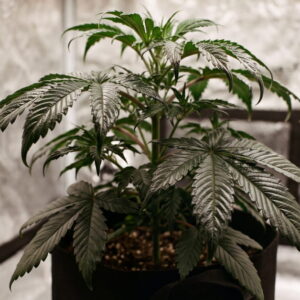
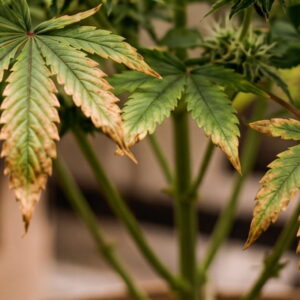
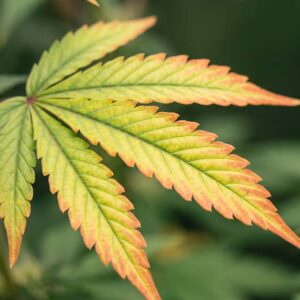
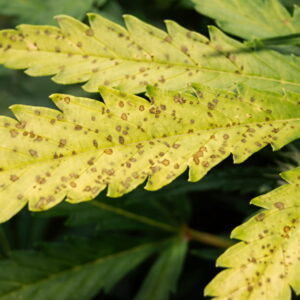
Potassium deficiency in cannabis shows first on the older, lower fan leaves, where the tips and edges turn tan or brown before the damage spreads inward and upward. The leaf margins curl, dry out, and feel brittle, and dark necrotic spots appear as tissue dies. Left alone, the deficiency climbs the plant and drags down overall vigor.
The sections below walk through the signals in order of how reliable each one is:
- Brown leaf edges and burnt tips — the strongest, most dependable sign of a potassium shortage.
- Purple or red stems — a weak, ambiguous signal that has several possible causes.
- Leaves turning white or yellow — often points away from a simple deficiency toward toxicity or another nutrient.
- Flowering-stage symptoms — when potassium demand peaks and the shortage does the most damage.
Brown Leaf Edges and Burnt Tips on Cannabis
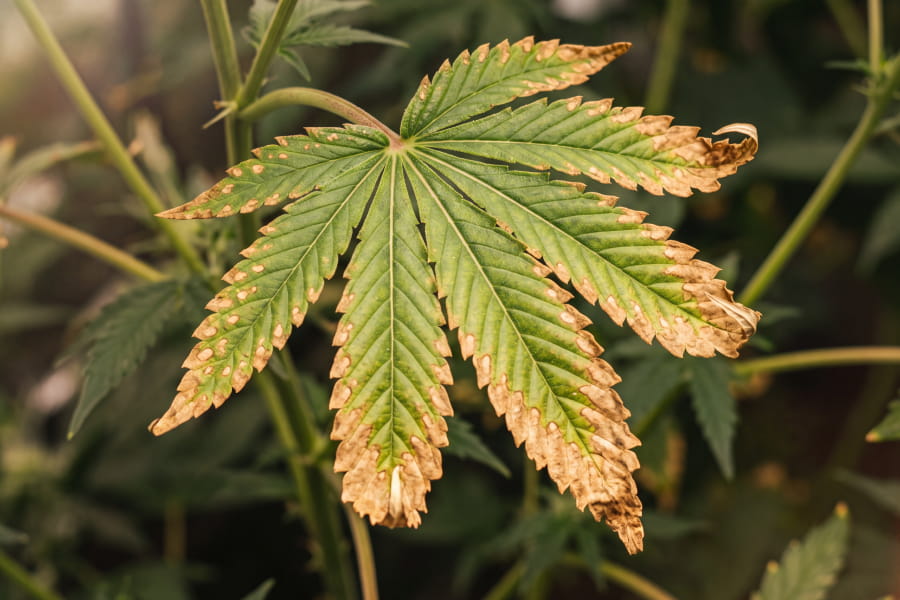
Brown leaf edges and burnt tips give you the clearest read on a potassium shortage in cannabis. The scorching starts at the outer rim of the older leaves, works inward, and leaves a dry, rust-colored border while the leaf center stays greener. Necrotic spots then break out across the blade, and the affected leaves curl and drop.
Because potassium is mobile, the plant pulls it from old leaves to feed new growth, so the oldest leaves always show damage first. What marks it as potassium specifically, and not a problem with other mobile nutrients, is the browning at the leaf edges and tips rather than a whole-leaf yellowing.
Chlorosis, the yellowing between veins, often trails the edge burn as the leaf continues to fade.
Why Cannabis Stems Turn Purple or Red
Purple or red stems make an unreliable diagnostic sign, because several unrelated conditions produce the same color.
Cold night temperatures, bright light, natural genetics, and a phosphorus shortage all turn stems and petioles reddish, and a potassium issue sometimes does too. On its own, stem color tells you very little.
Read purple stems as a prompt to check the leaves, not as proof of any single cause. If the lower fan leaves also show brown edges and burnt tips, potassium becomes the likely answer.
If the stems are the only symptom, the color is likely just genetics or cold stress, though it can also point to a phosphorus deficiency worth ruling out.
Cannabis Leaves Turning White or Yellow
Cannabis leaves turning white or yellow between the veins usually point somewhere other than a classic potassium shortage.
When the veins stay green and only the tissue between them pales, the cause is more often a magnesium deficiency than a lack of potassium, since a true potassium shortage browns the leaf edges first instead of washing out the center.
The exception is pale patches paired with edge burn, which point the other way toward potassium excess — the toxicity section below covers that case.
How Potassium Deficiency Affects Cannabis During Flowering
Potassium deficiency hits hardest during flowering, when cannabis plants pull the most potassium to build and fatten buds. The nutrient feeds the water pressure and sugar movement that add weight to flowers, so a shortage in bloom directly shrinks the harvest. Growers often notice the edge burn spreading right as the plant should be bulking up.
Flowering plants show the shortage as brown-edged fan leaves near the buds, slowed flower swelling, and stems too weak to support the colas.
The window to correct it is tight, because the plant has only a few weeks left to recover and finish. Catching the pattern early in bloom gives the plant time to redirect potassium back into the flowers.
Not sure if your plants have a potassium deficiency? Read the article Nutrient deficiencies in marijuana plants for a list with pictures of all deficiencies.
It is always best to ensure that no deficiencies will be present in your grow in the first place. By balancing your nutrients using my own recipe of NPK-balanced fertilizers, you will be able to get an amazing grow without deficiency issues!
ONE KIT, FULL GROW
- Full-cycle nutrition, no guesswork
- Sweeter, more flavorful buds at flower
- Matched formulas designed to work together
- Perfect for soil, coco, and soilless media
Is It Nutrient Burn or Potassium Deficiency?
No, nutrient burn and potassium deficiency are not the same problem, even though both scorch the leaf edges brown.
Nutrient burn comes from too much fertilizer and shows up as brown, crispy tips on the newest growth soon after a strong feed. Potassium deficiency comes from too little available potassium and shows up as browning along the edges of the older, lower leaves over time.
The distinction matters because the two problems need opposite fixes. Nutrient burn calls for flushing and cutting the feed, while a potassium shortage calls for restoring potassium and checking pH. Treating one as the other pushes the plant further off balance, so read the pattern before you act.
Brown tips that appear right after a heavy feed usually indicate nutrient burn rather than a potassium shortfall.
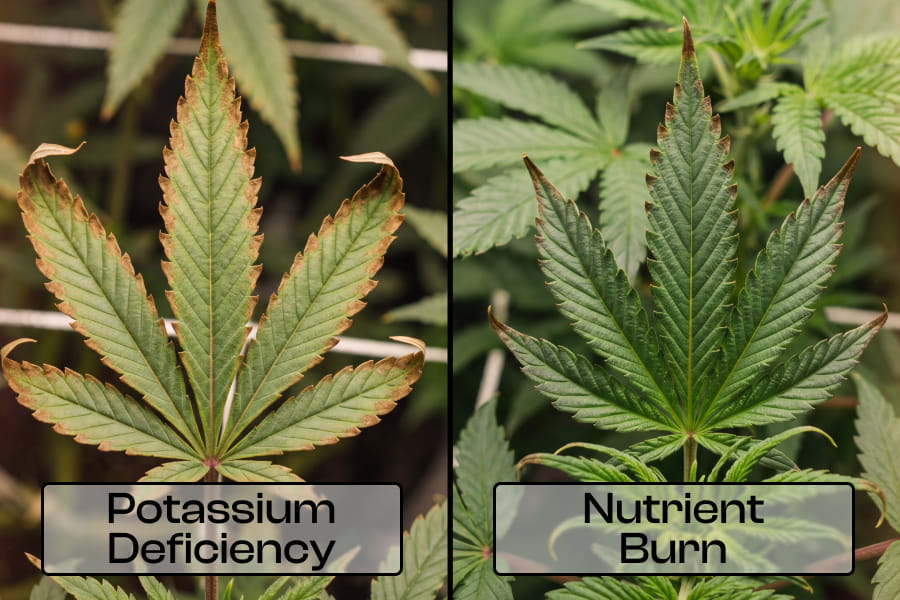
The differences below can help you distinguish potassium deficiency from nutrient burn based on where symptoms appear, how the leaf edges are affected, and when the symptoms develop.
Potassium Deficiency
- Where it starts: Older, lower fan leaves
- Edges vs. tips: Brown, curling edges and tips across the leaf
- Timing: Develops gradually over the course of the grow
- Stems and growth: Can cause weak stems and stalled bud development
- How to address it: Restore potassium levels and correct any pH issues
Nutrient Burn
- How to address it: Reduce feeding and flush the growing medium if appropriate
- Where it starts: Newest leaf tips
- Edges vs. tips: Brown, dry, crispy tips
- Timing: Often appears soon after a strong feeding
- Stems and growth: Growth is usually otherwise normal
Use the location of the damage as your anchor signal, since it separates the two problems most reliably. If you are still unsure, ease off the feed and check pH first, because that step is safe whether the cause turns out to be burn or shortage.
How Do You Fix Potassium Deficiency in Cannabis?
You fix potassium deficiency in cannabis by checking root-zone pH first, then restoring available potassium through a bloom-focused feed and monitoring the new growth.
Rushing to dump potassium onto a plant that actually has a pH problem wastes time and can trigger a fresh imbalance. Work the steps in order and give the plant several days to respond before changing anything else.
The three steps below move from the most common hidden cause to the direct correction:
- Check and correct root-zone pH — the fix that solves most false deficiencies before you add any nutrients.
- Potassium sources and bloom feeds — the products that restore potassium once pH is in range.
- Fixing the deficiency during flowering — how to correct it safely when the plant is already in bloom.
Always follow federal, state, and local rules on cannabis cultivation, and only grow where the law permits it.
Check and Correct Root-Zone pH First
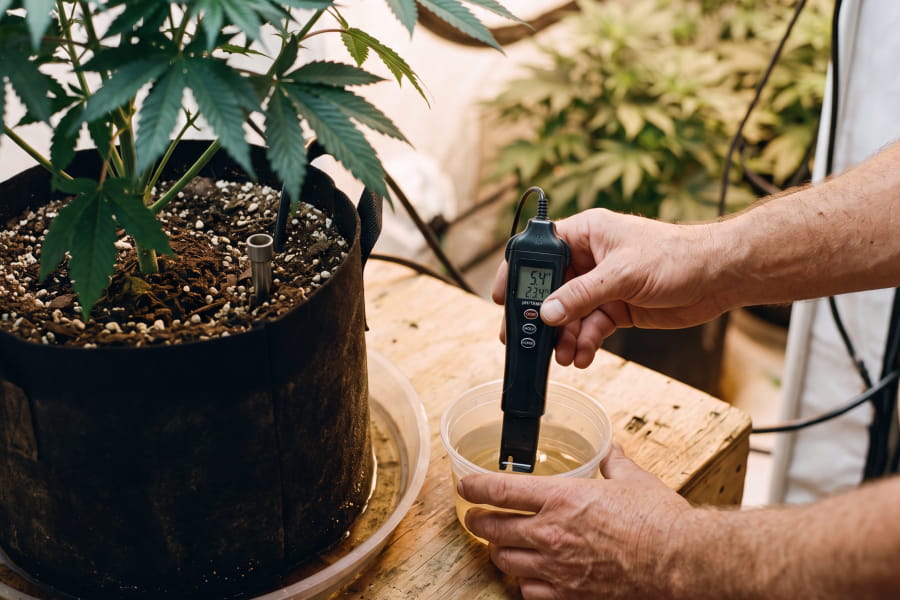
Root-zone pH controls whether the plant can absorb the potassium already present, so it comes first in any fix. Cannabis takes up potassium best when soil pH sits around 5.5 to 6.5 (aim for 6.0 to 6.3), while coco and hydro run a touch tighter at 5.6 to 6.4 (aim for 5.8 to 6.2).
Outside that range the roots cannot pull potassium in, and the plant shows deficiency symptoms even when the nutrient is right there, a problem growers call potassium lockout. Take a runoff or reservoir reading to see whether pH has drifted, and read it as a warning light, not a number to dial in to. The correction itself depends on what you’re growing in.
Living or organic soil holds its own pH steady through the root-zone microbes, so you leave the water alone and, if it has truly drifted, amend the soil slowly (lime to raise pH, elemental sulfur to lower it). In coco, hydro, or soil fed synthetic nutrients, mix your nutrient solution first and then bring it into range with pH Up or pH Down before it goes in.
Give the plant a few days and watch the newest growth for recovery. If fresh leaves come in clean, pH lockout was the cause and you may not need extra potassium at all.
Potassium Sources and Bloom Feeds for Cannabis
Potassium sources for cannabis range from fast-acting liquid feeds to slow-release soil amendments. A water-soluble bloom fertilizer high in potassium works quickest, because the roots take it up right away. Wood ash, liquefied kelp, potassium sulfate, potassium bicarbonate, and potassium silicate also supply the nutrient in available form.
Match the source to how fast you need results. For a plant showing active symptoms, a soluble bloom feed corrects the shortage within days, while greensand or granite dust release potassium slowly and suit longer-term soil building.
Whichever you choose, feed to the plant’s stage and avoid overcorrecting, since too much potassium creates its own problems.
How to Fix Potassium Deficiency During Flowering
Fixing a potassium deficiency during flowering calls for a measured correction, because the plant has limited time left to recover. Use a soluble bloom fertilizer with a higher potassium ratio, apply it at moderate strength, and confirm pH is in range so the roots can actually absorb it. A heavy late-bloom feed can shock the plant, so correct steadily rather than all at once.
Focus on protecting the flowers that remain rather than reversing all the leaf damage. Older scorched leaves will not turn green again, and that is fine, since the plant has already pulled what it needed from them. Steady potassium and correct pH give the buds their best chance to keep gaining weight through the final weeks.
Download my Harvest Guide! and learn to harvest marijuana and start getting higher yields.
Can Cannabis Have Too Much Potassium? Potassium Toxicity and Burn
Yes, cannabis can take up too much potassium, and the excess shows up as a nutrient lockout rather than a simple leaf burn. High potassium levels in the root zone crowd out other positively charged nutrients, especially calcium and magnesium, so the plant starves for those even when they are present.
Growers sometimes call this potassium toxicity or potassium burn, but the real damage comes from what the excess blocks.
The symptoms often mimic other deficiencies, which is what makes potassium toxicity tricky to spot. Excess potassium can block calcium uptake and trigger a calcium deficiency in new growth, showing as brown spots on young leaves, and it can drive interveinal yellowing that mimics a magnesium deficiency.
Because the picture overlaps with so many issues — including nutrient burn and a phosphorus deficiency that can also redden stems — confirm the cause before treating.
The fix is to flush the medium with pH-corrected water and rebalance the feed at a lower strength, so the plant regains access to the nutrients the excess was blocking.
Also read Identify marijuana plant problems
How to Prevent Potassium Deficiency in Cannabis
You prevent potassium deficiency in cannabis by matching feed strength to the plant’s stage and keeping root-zone pH in the uptake range. A balanced NPK schedule that shifts toward higher potassium during flowering covers demand at the point it peaks, and steady, moderate feeding avoids both the shortage and the excess that lockout brings.
Since most potassium problems trace back to absorption rather than supply, check pH regularly and avoid overfeeding, which causes nitrogen toxicity and other imbalances. Grow within federal, state, and local law, and treat consistent feeding as the simplest form of prevention.
How Seed Genetics Affect Nutrient Resilience
Seed genetics shape how well a cannabis plant withstands nutrient stress, including a potassium shortage. A plant with strong roots and steady growth handles a brief potassium dip far better than a weak, unstable one. Vigorous plants begin with high-quality cannabis seeds bred for consistent growth and predictable performance.
Seed choice also shapes the grow you’re setting up. Growers who want predictable, all-female gardens without culling males often choose feminized cannabis seeds. Those who prefer a shorter, simpler cycle tend toward autoflowering seeds, which finish faster and spend less time exposed to feeding mistakes along the way.
Starting a new grow and want to make sure no Potassium deficiency will pop up? I have created multiple grow sets which features all you need in order to grow healthy plants from seed to harvest!
FAQ — Cannabis Potassium Deficiency
Do Cannabis Plants Need Potassium?
Yes, cannabis plants need potassium to move water, run photosynthesis, and build flowers. Potassium supports healthy growth and firm bud development, so a shortage during flowering directly reduces yield. It ranks alongside nitrogen and phosphorus as one of the three primary macronutrients in any feed.
What Does Potassium Deficiency Look Like on Weed Leaves?
Potassium deficiency on weed leaves looks like brown, crispy edges and burnt tips on the older, lower fan leaves. Dark necrotic spots follow, the margins curl and dry, and the damage climbs the plant if left uncorrected. Weak stems and stalled bud growth often appear alongside the leaf symptoms.
Can a Potassium Deficiency Happen in Hydroponics?
No, a potassium deficiency rarely happens in recirculating hydroponic systems, because the reservoir keeps nutrients in steady supply. Soil and coco grows see it far more often, especially when pH drifts out of the uptake range. If a hydro plant shows edge burn, check pH and nutrient balance before assuming a true shortage.
Is Potassium Deficiency Worse During Flowering?
Yes, potassium deficiency is worse during flowering, because cannabis pulls the most potassium to build and fatten buds. A shortage in bloom shrinks flowers and weakens the stems that hold them, so it costs more yield than the same shortage in veg. Correcting it early in bloom gives the plant time to redirect potassium into the flowers.
How Is Potassium Deficiency Different From an Iron Deficiency?
Potassium deficiency and iron deficiency differ mainly in where the damage starts and how it looks. Potassium deficiency browns the edges of older, lower leaves, while iron deficiency yellows the newest top leaves between the veins. The location of the symptom tells the two apart most reliably.
Does More Potassium Increase THC?
No, adding more potassium does not increase THC in cannabis. Cannabis-specific research actually shows the opposite pattern: potassium-deficient plants can show higher cannabinoid concentrations as a stress response, though they yield less overall, so total cannabinoid output per plant still drops.
Cannabinoid levels depend on genetics, ripeness at harvest, and overall plant health far more than on any single nutrient. Feed for a healthy, well-balanced plant and let the genetics determine potency, rather than overdosing potassium.
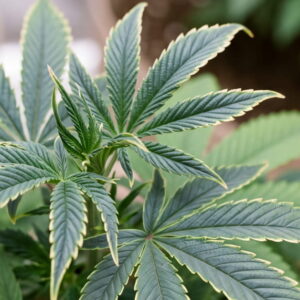
It’s just hard to tell whether it’s nutrient burn or potassium deficiency because they’re very similar. My tips of the leaves have turned blackish Brown but I’m also getting the the leaf Edge burn in the big fan leaves towards the bottom of the plant and some yellow spotting so it sounds like Nute burn and deficiency of nutrients at the same time
I have the exact same problem.
Love this
Hi I got 4 plants In not 4th week flower .3 look great as they should but one is very pale * yellow on the serations on the fingers of leaves .they all got exact same conditions help thanks
Tim,
Join us at: ilgmforum.com
There you can add images and get help from our many friendly members and expert support staff. Happy growing 🙂
I’m a first timer, growing 2 plants indoors in soil.
2 weeks into flowering one of them has a few leaves turning yellow and the other has some leaves with Brown spots. Not sure what to do, any suggestions would be appreciated!
Tim, Join our forum at: ilgmforum.com We are much better suited to help you learn from there. Thanks 🙂
i start seeds in fox farm soil and i only use water only works for me
Good info
[…] You also might notice areas where growth slows or becomes irregular. Remember that potassium is very important to the transfer of water and other nutrients throughout the plant. This means that if you have a large deficiency, it can affect the health of the whole plant. To treat your potassium deficiencies, try adjusting the fertilizer mix you are using or add a water-soluble potassium additive. Read more about potassium deficiencies in marijuana plants. […]
[…] will not be optimum. Three foundational nutrients that you will need to focus on are nitrogen (N), potassium (P), and phosphorus (K). The fewer these nutrients, the less weed you will […]
[…] describe the nutrients that cannabis plants need the most. This list includes phosphorus, nitrogen, potassium, magnesium, calcium, and sulfur. Micronutrients refer to the remaining nutrients that are necessary […]
[…] Potassium deficiency […]