

Cannabis zinc deficiency shows up as yellowing between the veins on new top growth, paired with small, twisted leaves and tight spacing between the newest nodes. Most cases trace back to root-zone pH drifting too high, which locks out the zinc your plant already has rather than a true shortage in the medium.
This guide walks through the symptoms that confirm zinc, the pH-lockout mechanism behind it, and the step-by-step fix that greens new growth back up. It also covers how to keep the deficiency from returning in your next grow.
The short answer: Most cannabis zinc deficiency is pH lockout, so check your root-zone pH first. Correct it to 5.5 to 6.5 in soil (6.0 to 6.3 is ideal) or 5.6 to 6.4 in hydro (5.8 to 6.2 is ideal), clearing salt buildup with a flush first only if needed. Next, feed a micronutrient mix if new growth still lags. The twisted, small new leaves are the tell that separates zinc from iron or manganese.
What Causes Zinc Deficiency in Cannabis Plants?
Zinc deficiency in cannabis develops when the plant cannot take up zinc, usually because the root-zone pH sits outside the range where zinc stays soluble. The zinc is often present in the soil or reservoir, but the roots cannot absorb it until pH returns to the correct band.
A smaller share of cases comes from soil that genuinely lacks zinc, which shows up more in reused or heavily leached mediums.
Wherever cultivation is lawful under federal, state and local rules, the diagnosis starts the same way: rule out pH before you assume the medium is empty of zinc.
Zinc’s Role in Cannabis Growth and Auxin Production
Zinc drives cannabis growth by activating auxin, a hormone that controls stem elongation and the formation of new leaves. When auxin production drops, shoots and leaves stop extending, so the plant stays short and the newest growth bunches together.
Zinc also supports chlorophyll production and works inside several plant enzymes, which is why a shortage drains color from young tissue first. These functions concentrate in new growth, and that is exactly where the deficiency becomes visible.
Why pH Lockout Triggers Zinc Deficiency in Cannabis
pH lockout is the reason a plant can sit in zinc-rich soil and still starve; the nutrient is there, the roots just can’t pull it in.
Zinc stays soluble and reachable across soil pH 5.5 to 6.5 (best around 6.0 to 6.3) and hydro or coco pH 5.6 to 6.4 (best around 5.8 to 6.2), and it falls out of reach as pH climbs past those bands.
Because the zinc is already present, correcting pH usually restores uptake on its own, without dosing anything extra. That is why a pH reading is the first diagnostic step, not the last resort.

ONE KIT, FULL GROW
- Full-cycle nutrition, no guesswork
- Sweeter, more flavorful buds at flower
- Matched formulas designed to work together
- Perfect for soil, coco, and soilless media
Cannabis Zinc Deficiency Symptoms: What to Look For
Zinc symptoms follow a recognizable progression, which makes them easier to catch early if you know the order they appear in. The first leaves to fade are the youngest at the top, where color drains from the tissue between the veins while the veins hold their green.
As it advances, those new leaves stay small and twist, and the space between the top nodes shortens so the shoots look bunched and tangled. Leaf tips on affected growth take on distorted color and can dry out and die, and in flower, developing buds may stall and stop gaining weight.
The most reliable way to read these signals is to work from the strongest to the weakest, since several symptoms overlap with other micronutrient problems.

- New-growth location: hits the newest leaves, not the old lower — high reliability.
- Interveinal pattern: color drains between the veins while the veins stay green — high reliability.
- Twisting and short nodes: small, curled leaves with tight node spacing — the zinc-specific tell.
- Tip death: leaf tips discolor and die back — medium reliability, appears later.
How to Tell Zinc Deficiency from Iron and Manganese Deficiency
Zinc, iron and manganese deficiency all strike new cannabis growth, so the distinguishing signal is the leaf twisting and shortened node spacing that only zinc produces.
Iron deficiency yellows new leaves too, but the veins stay sharply green and leaf size stays normal. Manganese deficiency adds brown flecks or spots to the interveinal yellowing. All three usually share the same underlying cause — high-pH lockout — so the comparison below helps you name which micronutrient before you treat.
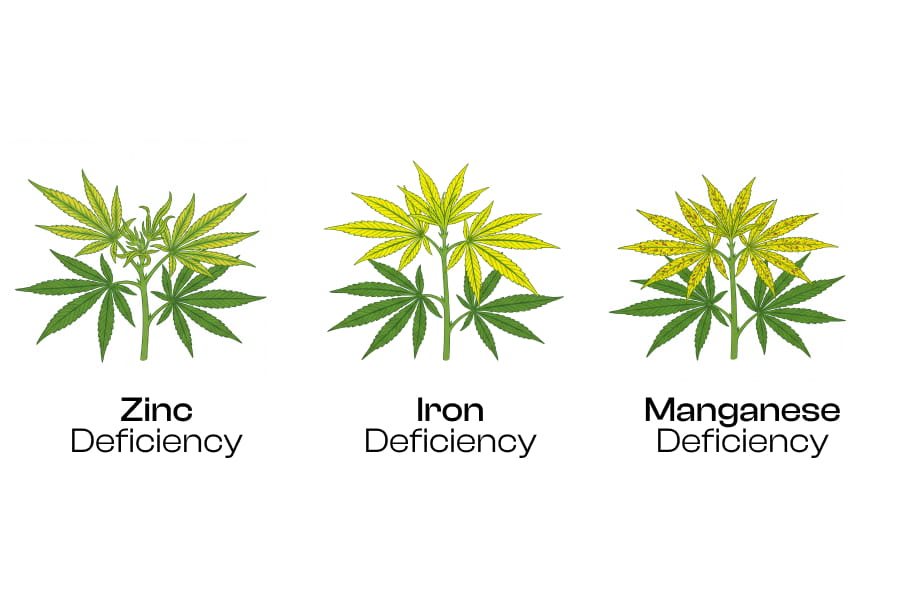
The table maps each trait against the three deficiencies and rates how reliably it points to the answer.
| Trait | Zinc deficiency | Iron deficiency | Manganese deficiency | Reliability |
| Where it starts | New / top growth | New / top growth | New growth, spreads to mid | High |
| Interveinal yellowing | Yes | Yes, greener veins | Yes, with brown flecks | High |
| Leaf size and shape | Small, twisted, tangled | Normal size | Normal to mottled | High (zinc-specific) |
| Node spacing | Shortened | Normal | Normal | High (zinc-specific) |
| Leaf tips | Distorted color, dying | Rarely tip death | Brown spotting | Medium |
| Usual cause | pH lockout (high) | pH lockout (high) | pH lockout (high) | High |
When leaf twisting and short nodes appear alongside interveinal yellowing, zinc is the confirmed cause. Without those two signals, treat the diagnosis as suspected and check pH and node spacing before dosing anything.
Zinc Deficiency vs Zinc Toxicity in Cannabis
Zinc toxicity in cannabis appears rarely, but when it does, it shows as wilting rather than the interveinal yellowing of a deficiency — and in severe cases it can kill the plant.
A plant showing whole-plant wilting without the classic interveinal yellowing is unlikely to need more zinc. Adding zinc to a plant that already has too much makes the problem worse. When symptoms don’t match the deficiency pattern, stop and investigate before feeding.
Download my free Grow Bible for more growing tips.
How to Fix Zinc Deficiency in Cannabis Plants
Fixing cannabis zinc deficiency starts with resetting the root-zone pH, because most cases resolve once the plant can take up the zinc already present. The fix runs in two steps, with supplementation only mattering once uptake is restored.
- Step 1 — Correct the root-zone pH: bring the root zone back into the zinc-uptake range, clearing salt buildup first only if it’s present.
- Step 2 — Supplement: feed the zinc-iron-manganese micronutrient group together, if new growth still lags after the reset.
Step 1 — Correct the Root-Zone pH
Start by testing the runoff or reservoir to see where your pH sits, and read that number as a drift signal (not a target to adjust anything toward). Zinc locks out when the root zone runs high, so you’re usually bringing pH down, but confirm it against your reading first.
Check runoff EC too. If it’s higher than what you fed in, it signals salt buildup. In that case, flush first, with plain pH-corrected water until about 30% drains. Then move onto pH correction.
In coco, hydro, or soil fed synthetic nutrients, dissolve your nutrients into water first — that mixed solution is what needs to be in range. Adjust it with pH Down (or pH Up, if the reading shows it running low) before feeding.
Organic soil buffers its own pH through the microbes, so genuine drift is uncommon. If a soil test does read high, ease it down with a slow amendment such as elemental sulfur rather than pH-ing the water. If the reading is already on target, zinc isn’t locked out and the shortage is a true one — skip the pH step and move to Step 2.
With pH back in range, resume feeding at about half strength so uptake re-establishes gradually, and hold it steady for several days. Keep your eye on the newest growth, since that is where recovery appears first. In most zinc cases, this alone brings the plant back before any supplement is needed.
Step 2 — Supplement Zinc with a Micronutrient Mix
Supplementing zinc through a micronutrient mix restores the zinc-iron-manganese group together, because these three micronutrients move and deplete as a set. A balanced micronutrient supplement — or a cal-mag product that includes trace elements — covers all three at once.
Standalone options like zinc sulfate, zinc oxide and chelated zinc also work, and chelated forms (zinc bound to an organic molecule for easier uptake) stay available across a wider pH range.
Give the plant a few days after supplementing to push out healthy new growth before adjusting anything further.
Also read the article Nutrient deficiencies in marijuana plants for a list with pictures of all deficiencies.
How to Prevent Zinc Deficiency in Future Cannabis Grows
Preventing cannabis zinc deficiency depends on steady pH management and complete feeding from seedling through flower. Test root-zone pH regularly and keep it inside the zinc-uptake band, since drift is the single most common trigger.
Feed a nutrient line that includes micronutrients rather than relying on base nutrients alone, and watch your runoff or reservoir EC so you catch salt buildup early. In coco, feeding to a little runoff keeps salts moving through. In hydro, refresh the reservoir on schedule. In living soil, flush only when buildup actually shows, since routine flushing strips the microbes.
Because zinc, iron deficiency and manganese deficiency typically trace back to the same high-pH lockout, one pH correction often prevents all three.
The same lockout pattern reaches other trace nutrients, so a plant fighting zinc is often one pH swing away from the next shortage. Watching for copper deficiency alongside zinc catches the whole group early, since a complete micronutrient feed protects more than just one element.
Healthy Genetics and the Zinc Deficiency Connection
Zinc deficiency responds to feeding fixes, but vigorous starting genetics give cannabis plants a stronger baseline to resist and recover from micronutrient stress. A plant with robust genetics puts out steadier new growth, which makes early symptoms easier to spot and quicker to reverse.
Starting a grow with vigorous cannabis seeds from a reliable source gives plants that stronger baseline against pH swings and nutrient lockout. Genetics also shape how forgiving a plant is when conditions slip.
Growers who want an all-female crop without sexing and culling males often start with feminized weed seeds, which keeps attention on feeding and pH rather than plant-sex sorting. Fast-finishing autoflower seeds move from seedling to harvest on their own schedule, so keeping a steady root zone from day one lets them run that quick cycle straight through to a clean finish.
Matching seed type to your setup builds in a margin that makes the occasional pH slip easier to absorb.
Cannabis Zinc Deficiency FAQ
What Does Zinc Deficiency Look Like on Cannabis?
Zinc deficiency shows as yellowing between the veins on new top growth, with small twisted leaves and shortened spacing between the newest nodes. The veins stay green while the tissue between them fades, and leaf tips can discolor and die. Twisting and tight node spacing are the signals that separate zinc from iron and manganese.
How Long Does It Take Cannabis to Recover From Zinc Deficiency?
Cannabis usually pushes out healthy new growth three to five days after the cause is corrected. The pH correction acts fastest, while damaged leaves won’t turn green again — recovery is visible in the fresh growth above them. Watch the newest shoots as your recovery signal rather than the already-affected leaves.
Can Zinc Deficiency Happen in Coco or Hydro?
Zinc deficiency happens in coco and hydro just as it does in soil, and it’s often driven by an out-of-range pH. Keep hydro and coco pH between 5.6 and 6.4, with 5.8 to 6.2 as the sweet spot, to keep zinc available to the roots. Because these mediums hold fewer buffers than soil, pH drifts faster and needs more frequent checks.
Is Zinc Deficiency the Same in All Plants or Just Cannabis?
Zinc deficiency follows the same pattern across most plants: interveinal yellowing on new growth, small leaves and stunted shoots. Cannabis shows the same distinctive twisting and shortened node spacing, which makes it easier to confirm. The pH-lockout cause and the correction steps apply broadly, though the exact pH target varies by plant and medium.
What pH Stops Zinc Lockout in Cannabis?
Soil held between 5.5 and 6.5 (6.0 to 6.3 is the target) and hydro or coco between 5.6 and 6.4 (5.8 to 6.2 is the target) keeps zinc available to the roots. Above that range, zinc falls out of solution and the roots can’t absorb it even when it’s present. Bringing pH back into the band usually restores uptake on its own.
Can Too Much Zinc Hurt Cannabis Plants?
Too much zinc harms cannabis plants, though toxicity is rare compared with deficiency. Excess zinc causes wilting and, in severe cases, can kill the plant. If a plant wilts without the interveinal yellowing of a deficiency, stop adding zinc and investigate before feeding more.
Thanks for reading. Please leave comments or questions below and don’t forget to download my free grow bible
Robert







I’m not sure when I am experiencing is a zinc deficiency it is only the very tips new leaves that are showing a tiny amount of yellow it is on day 13 of flower the plant looks gorgeous except for this recent occurrence
THe light might be to close to the top of the plant
Plant is 10 inches tall seems to be turning yellow
Obviously you have to correct pH under 6.8 all time
If you have 8 PH tap water and more 25 Celsius degrees temp you have to supplement zinc no way if you use soil, I empirical use zinc citrate ( zinc anode and carbon or silver anode in a satured boiled citric acid Solution at 6v) it’s empirical but use 3ml for l for veg and 6 or 9 for veg and enjoy it ahahahah
I hope this is not the mind set of this community.
Fortunately it’s not 😀
im looking for that KK. help son
Why would somebody give you free free seeds for some dick reason like that. What a prick
[…] only occur in small amounts, especially when compare to the macronutrients. Micronutrients include zinc, copper, iron, boron, manganese, and molybdenum. A good option is the Marijuana Booster. A great […]
I needed to certae you this little observation to help thank you very much as before for all the marvelous views you’ve shown on this page. It’s quite extremely open-handed of people like you to supply unreservedly precisely what many individuals would’ve distributed for an electronic book in making some profit on their own, chiefly since you could have tried it in case you wanted. These thoughts in addition worked like a good way to recognize that the rest have the same fervor just as my own to understand much more related to this problem. I think there are several more fun instances in the future for folks who view your blog post.
[…] Zinc deficiency […]